
No — the presence or magnitude of delayed-onset muscle soreness (DOMS) does not indicate, predict, or correlate with subsequent muscle hypertrophy, and current evidence suggests muscle damage is not the process that mediates or potentiates resistance training-induced hypertrophy.[1]
Muscle damage and soreness are highest with unaccustomed exercise (e.g., early training sessions or novel eccentric-biased work), and this response diminishes rapidly with repeated exposure — the "repeated bout effect" — even as hypertrophy continues to progress with a well-designed training program.[2][3] In a study using deuterium oxide-labeled myofibrillar protein synthesis (MyoPS) and biopsy-confirmed Z-band streaming (a marker of muscle damage), MyoPS and damage were both highest after the initial exercise bout, but neither correlated with eventual hypertrophy. Only after damage was attenuated with training (weeks 3 and 10) did MyoPS correlate strongly with fiber cross-sectional area gains (r ≈ 0.9).[4] This indicates that the anabolic signal driving true hypertrophy emerges after the muscle adapts and damage subsides, not because of the damage itself.
Consistent with this, resistance training protocols that minimize muscle damage produce hypertrophy and strength gains comparable to those that provoke greater damage and soreness, and early increases in muscle cross-sectional area during the first sessions of a program are attributable largely to damage-induced swelling/edema rather than true contractile tissue accretion.[1][5] Mechanistically, DOMS itself may reflect nociceptor sensitization and even neural microdamage rather than a signal of productive muscle remodeling, and poor correlation exists between perceived soreness and biochemical markers of damage.[6][7]
Practically, this means soreness should not be used as a proxy for training effectiveness, nor should its absence suggest an inadequate stimulus — hypertrophic adaptation depends on cumulative mechanical tension, progressive overload, and sustained increases in myofibrillar protein synthesis over time rather than on the degree of muscle damage or soreness experienced.[4][1]
References
- The Development of Skeletal Muscle Hypertrophy Through Resistance Training: The Role of Muscle Damage and Muscle Protein Synthesis. Damas F, Libardi CA, Ugrinowitsch C. European Journal of Applied Physiology. 2018;118(3):485-500. doi:10.1007/s00421-017-3792-9.
- Myofibrillar protein synthesis rates are increased in chronically exercised skeletal muscle despite decreased anabolic signaling. Langer HT, West D, Senden J, et al. Scientific Reports. 2022;12(1):7553. doi:10.1038/s41598-022-11621-x.
- The molecular athlete: exercise physiology from mechanisms to medals. Furrer R, Hawley JA, Handschin C. Physiological Reviews. 2023;103(3):1693-1787. doi:10.1152/physrev.00017.2022.
- Resistance Training-Induced Changes in Integrated Myofibrillar Protein Synthesis Are Related to Hypertrophy Only After Attenuation of Muscle Damage. Damas F, Phillips SM, Libardi CA, et al. The Journal of Physiology. 2016;594(18):5209-22. doi:10.1113/JP272472.
- Does Exercise-Induced Muscle Damage Play a Role in Skeletal Muscle Hypertrophy?. Schoenfeld BJ. Journal of Strength and Conditioning Research. 2012;26(5):1441-53. doi:10.1519/JSC.0b013e31824f207e.
- Have We Looked in the Wrong Direction for More Than 100 Years? Delayed Onset Muscle Soreness Is, in Fact, Neural Microdamage Rather Than Muscle Damage. Sonkodi B, Berkes I, Koltai E. Antioxidants (Basel, Switzerland). 2020;9(3):E212. doi:10.3390/antiox9030212.
- Susceptibility to movement-evoked pain following resistance exercise. Kodesh E, Sirkis-Gork A, Mankovsky-Arnold T, Shamay-Tsoory S, Weissman-Fogel I. PloS One. 2022;17(7):e0271336. doi:10.1371/journal.pone.0271336.
>> 그럼 근비대를 유의미하게 예측할 수 있는 인자들에는 무엇이 있나요?
Weekly training volume (sets per muscle group per week) is the variable most strongly and consistently associated with long-term muscle hypertrophy, with load and frequency playing much smaller, largely permissive roles once volume is matched.
Volume
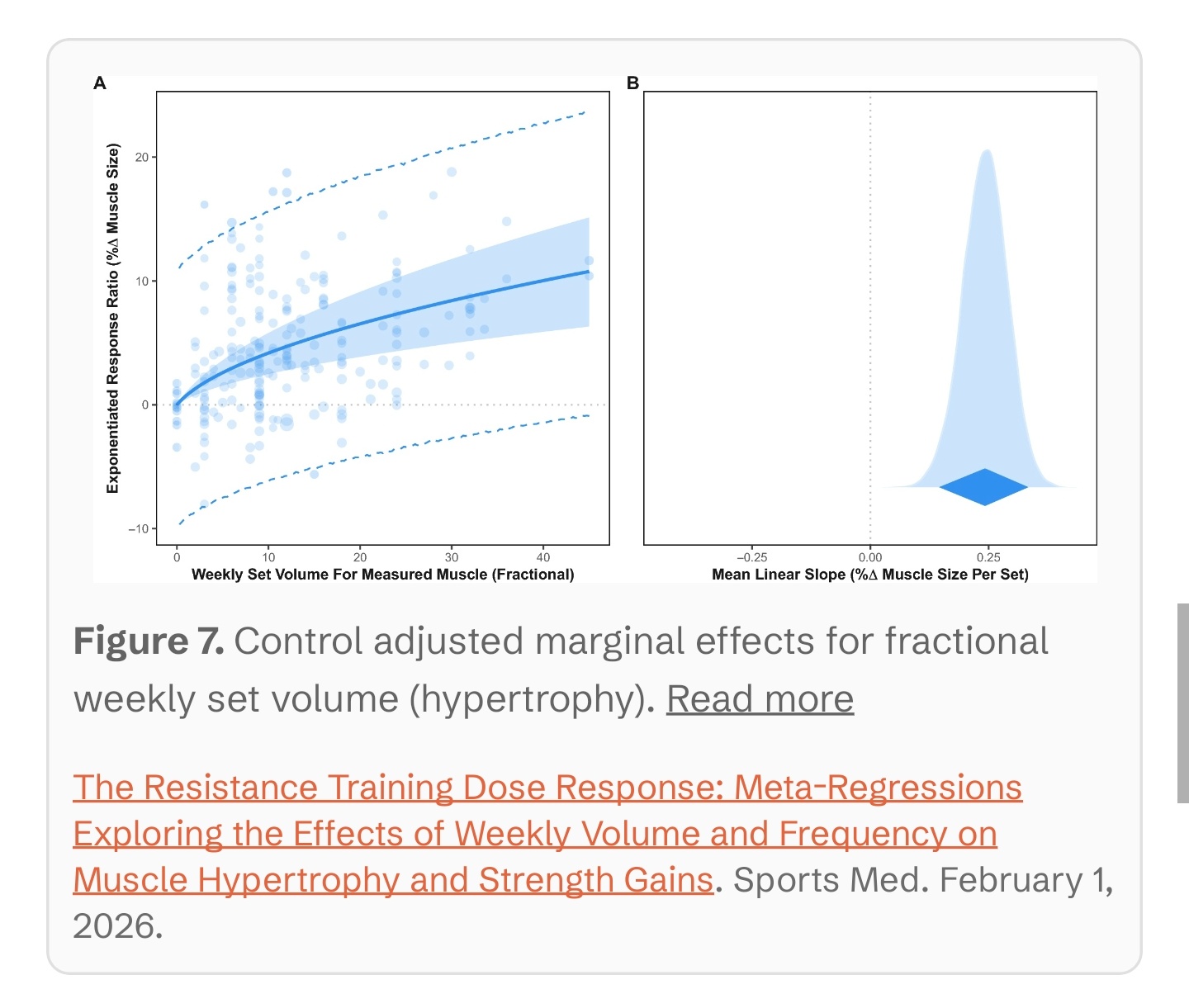
A dose-response relationship exists between weekly set volume and hypertrophy, with growth increasing as additional sets are added but with progressively diminishing returns (a square-root/curvilinear relationship) — the marginal benefit of each additional set decreases as total volume rises, though no clear plateau has been identified within the commonly studied range (median ~10.5 sets/muscle group/week across trials).[1] The ACSM position stand similarly notes that hypertrophy is enhanced by higher volume (≥10 sets/muscle group/week) compared with lower volume when other variables are held constant, and other meta-analyses describe an approximate minimum of 10 sets per muscle group per week as an effective threshold, with a possible U-shaped relationship at higher volumes.[2][3]
Here is the dose-response figure from the Pelland et al. meta-regression illustrating this relationship:
Load
Load (intensity, % 1RM) has comparatively little independent effect on hypertrophy across a wide range — low-load, high-volume training performed to fatigue (e.g., 30% 1RM to failure) produces myofibrillar protein synthesis and hypertrophy responses similar to high-load, low-volume training (e.g., 90% 1RM), provided volume/effort is matched.[4] The ACSM overview of reviews likewise found no significant hypertrophy difference between low (30% 1RM) and high (100% 1RM) loads.[2] Traditional guidance still favors moderate-to-heavy loads (~70–80% 1RM, 8–12 reps) for practical efficiency, but this is not a strict physiological requirement for growth.[4][5]
Frequency
Training frequency (sessions per muscle group per week) has little independent effect on hypertrophy when total weekly volume is equated — its main value is providing more sessions across which to distribute a given volume, which improves recoverability and training quality rather than adding a distinct stimulus.[2][3]
Proximity to failure
Training closer to failure (lower repetitions-in-reserve) shows a modest dose-response relationship with greater hypertrophy in meta-regression data, though head-to-head trials show only a trivial average advantage for training to set failure versus non-failure, with no significant moderating effect of volume load or relative load.[6][7] Because training to failure increases fatigue and recovery cost, it need not be the default approach — moderate proximity to failure appears sufficient for most volume-matched hypertrophy outcomes.[7][8]
Taken together, the strongest actionable lever for long-term hypertrophy is progressively accumulating adequate weekly volume (roughly ≥10 hard sets/muscle group/week, individualized and periodized upward as tolerated), while load and frequency can be adjusted flexibly based on preference, joint tolerance, and logistics without compromising growth.[2][1][3]
References
- The Resistance Training Dose Response: Meta-Regressions Exploring the Effects of Weekly Volume and Frequency on Muscle Hypertrophy and Strength Gains. Pelland JC, Remmert JF, Robinson ZP, Hinson SR, Zourdos MC. Sports Medicine (Auckland, N.Z.). 2026;56(2):481-505. doi:10.1007/s40279-025-02344-w.
- American College of Sports Medicine Position Stand. Resistance Training Prescription for Muscle Function, Hypertrophy, and Physical Performance in Healthy Adults: An Overview of Reviews. Currier BS, D'Souza AC, Singh MAF, et al. Medicine and Science in Sports and Exercise. 2026;58(4):851-872. doi:10.1249/MSS.0000000000003897.
- Optimal resistance training prescriptions to improve muscle strength, physical function, and muscle mass in older adults diagnosed with sarcopenia: a systematic review and meta-analysis. Yan R, Chen Y, Zhang R, et al. Aging Clinical and Experimental Research. 2025;37(1):320. doi:10.1007/s40520-025-03235-w.
- The molecular athlete: exercise physiology from mechanisms to medals. Furrer R, Hawley JA, Handschin C. Physiological Reviews. 2023;103(3):1693-1787. doi:10.1152/physrev.00017.2022.
- American College of Sports Medicine Position Stand. Progression Models in Resistance Training for Healthy Adults. Medicine and Science in Sports and Exercise. 2009;41(3):687-708. doi:10.1249/MSS.0b013e3181915670.
- Exploring the Dose–Response Relationship Between Estimated Resistance Training Proximity to Failure, Strength Gain, and Muscle Hypertrophy: A Series of Meta-Regressions. Robinson ZP, Pelland JC, Remmert JF, et al. Sports Medicine (Auckland, N.Z.). 2024;54(9):2209-2231. doi:10.1007/s40279-024-02069-2.
- Influence of Resistance Training Proximity-to-Failure on Skeletal Muscle Hypertrophy: A Systematic Review with Meta-analysis. Refalo MC, Helms ER, Trexler ET, Hamilton DL, Fyfe JJ. Sports Medicine (Auckland, N.Z.). 2023;53(3):649-665. doi:10.1007/s40279-022-01784-y.
- Methods for Controlling and Reporting Resistance Training Proximity to Failure: Current Issues and Future Directions. Pelland JC, Robinson ZP, Remmert JF, et al. Sports Medicine (Auckland, N.Z.). 2022;52(7):1461-1472. doi:10.1007/s40279-022-01667-2.
'의학공부' 카테고리의 다른 글
| 근이완제, 근합성을 방해하나요? (0) | 2026.09.06 |
|---|---|
| 내장지방과 허벅지 살, 둘 중에 건강에 좋은 건 뭘까? (0) | 2026.09.05 |
| 탈모를 예방하는 과학적으로 증명된 습관이 있을까? (0) | 2026.09.03 |
| 운동한 뒤 찬물샤워, 건강에 진짜 도움이 될까? (0) | 2026.08.20 |
| 골관절염, 아픈데 왜 운동하라는 걸까? (0) | 2026.08.20 |


