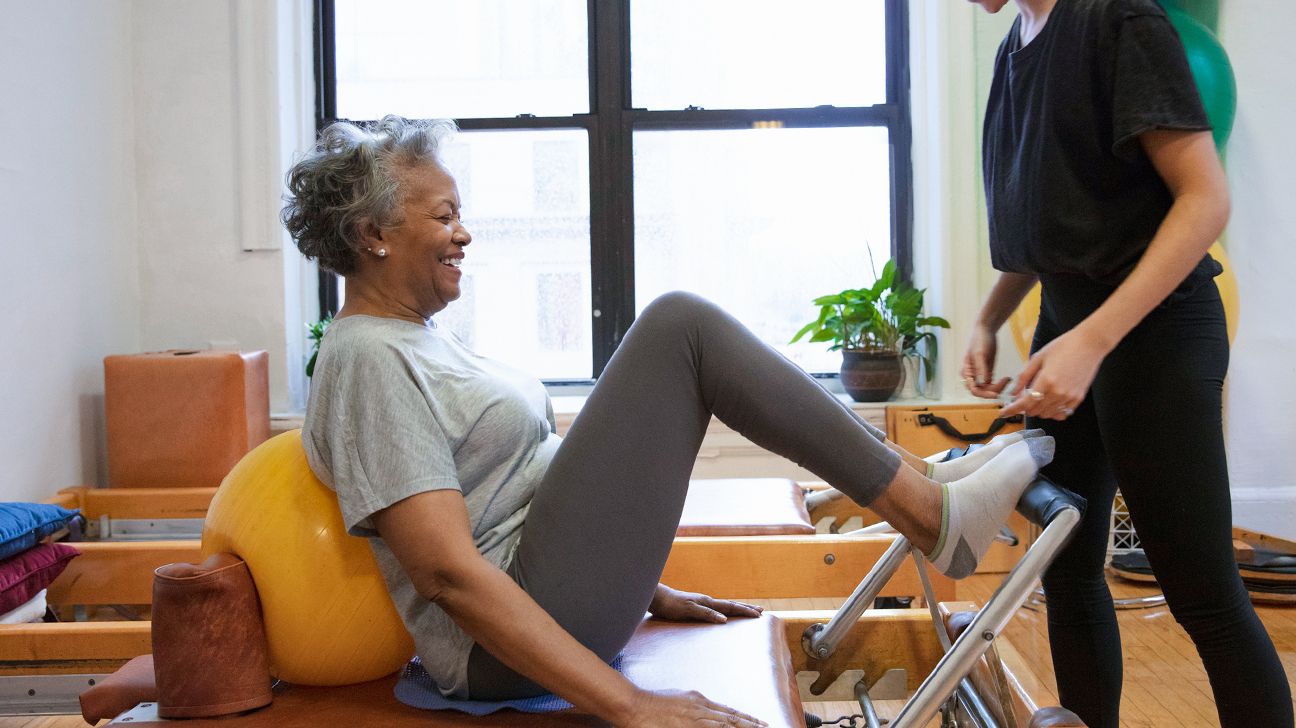
Moderate exercise outperforms a sedentary lifestyle in knee OA because it acts on multiple pathogenic mechanisms simultaneously — muscular, inflammatory, mechanical, and metabolic — rather than simply avoiding joint irritation as is often assumed.
Muscular and biomechanical mechanisms
Muscle weakness (particularly quadriceps) is common in OA and contributes to abnormal joint loading; exercise-induced strength gains improve pain and function, though recent evidence suggests strength improvement mediates only a modest portion of the overall benefit.[1] Exercise also improves sensorimotor control, functional stability, and range of motion, and reduces fall risk.[2]
Anti-inflammatory effects
Aerobic exercise reduces circulating pro-inflammatory cytokines and helps balance pro- versus anti-osteoclastogenic signaling, which contributes to reduced pain and may support cartilage preservation.[1][3] This is a key mechanistic distinction from sedentary behavior, which is associated with a pro-inflammatory, deconditioned state.
Weight and metabolic effects
Exercise helps maintain a healthy weight and reduces visceral adipose tissue, lowering both mechanical joint load and adiposity-driven systemic inflammation — a mechanism particularly relevant since weight loss (with exercise plus diet) has been associated with slowed cartilage degeneration on compositional MRI and better pain, function, and walking distance than either intervention alone.[2]
Cartilage/joint homeostasis
Mechanistic work indicates that joint loading has a U-shaped or dose-dependent effect: moderate loading appears to reduce chondrocyte apoptosis, matrix degradation, and oxidative stress in osteoarthritic joints, whereas both high-intensity/prolonged loading and immobilization (sedentary state) each promote cartilage degradation through different pathways.
Evidence against sedentary behavior specifically
Observational data (NHANES) show >9 hours/day of sitting is associated with a 36% increased odds of OA, an association attenuated in those who engage in moderate recreational activity.[4] Mendelian randomization studies support a likely causal relationship, with genetically predicted sedentary behavior associated with ~20% higher OA risk (IVW OR 1.20) and physical activity inversely associated with risk (IVW OR 0.85).[5] Notably, in the Osteoarthritis Initiative, even modest activity — as little as 1 hour/week of moderate-to-vigorous activity, or more time in light-intensity activity — was associated with a lower likelihood of developing disability compared with less than 1 hour/week.[2]
Reassurance on safety
Concerns that exercise might accelerate OA are not borne out: systematic review data in older adults with knee pain/OA show no increase in pain and no group-level progression of disease on imaging with low-impact exercise.[2]
In short, the rationale is not merely "avoid worsening the joint" but that moderate exercise actively counteracts the inflammatory, muscular-deconditioning, and metabolic drivers of OA progression that sedentary behavior promotes.
References
- Exercise for Osteoarthritis of the Knee. Lawford BJ, Hall M, Hinman RS, et al. The Cochrane Database of Systematic Reviews. 2024;12:CD004376. doi:10.1002/14651858.CD004376.pub4.
- Osteoarthritis of the Knee. Sharma L. The New England Journal of Medicine. 2021;384(1):51-59. doi:10.1056/NEJMcp1903768.
- Clinical Effect and Mechanism of Aerobic Exercise for Knee Osteoarthritis: A Mini Review. Hu HY, Jia LN, Zhao WY, et al. Frontiers in Physiology. 2025;16:1708750. doi:10.3389/fphys.2025.1708750.
- Association Between Daily Sitting Time and Osteoarthritis Based on the National Health and Nutrition Examination Survey (NHANES) 2007 to 2018: A Cross-Sectional Study. Chen Z, Wei W, Li R, et al. Medicine. 2026;105(10):e47940. doi:10.1097/MD.0000000000047940.
- Association Between Sedentary Behavior, Physical Activity, and Osteoarthritis: Results From NHANES 2007-2020 and Mendelian Randomization Analysis. He J, Zhang C, Yang L. Frontiers in Public Health. 2024;12:1454185. doi:10.3389/fpubh.2024.1454185.
'의학공부' 카테고리의 다른 글
| 탈모를 예방하는 과학적으로 증명된 습관이 있을까? (0) | 2026.09.03 |
|---|---|
| 운동한 뒤 찬물샤워, 건강에 진짜 도움이 될까? (0) | 2026.08.20 |
| 진통제, 근합성에 영향을 주는가? (0) | 2026.08.16 |
| 야외 걷기 vs 실내 워킹머신, 건강 면에서 차이가 있을까? (0) | 2026.08.16 |
| 밥 먹고 나서 운동, 정말 효과가 있을까? (0) | 2026.08.16 |


